
Walking the neighborhood with a stroller in one hand and a preschooler clutching the other feels totally routine, right up until a car rolls through the intersection while the walk sign is still glowing white. That jolt of adrenaline reminds you just how fast an ordinary outing can turn scary, especially when 22.2% of traffic collisions stem from a driver making a left turn.
A lot of families assume that white painted lines and flashing signals guarantee a safe crossing, but real-life traffic patterns are messier than that. With pedestrians frequently injured in intersection crashes, understanding crosswalk laws goes well beyond teaching your kids to look both ways. It means knowing traffic rules, recognizing where motorists must yield, and understanding why certain street corners demand extra caution for anyone pushing a stroller. If you’ve ever felt your stomach drop watching a sedan gun it through a turn while your toddler is mid-crosswalk, this guide is for you.

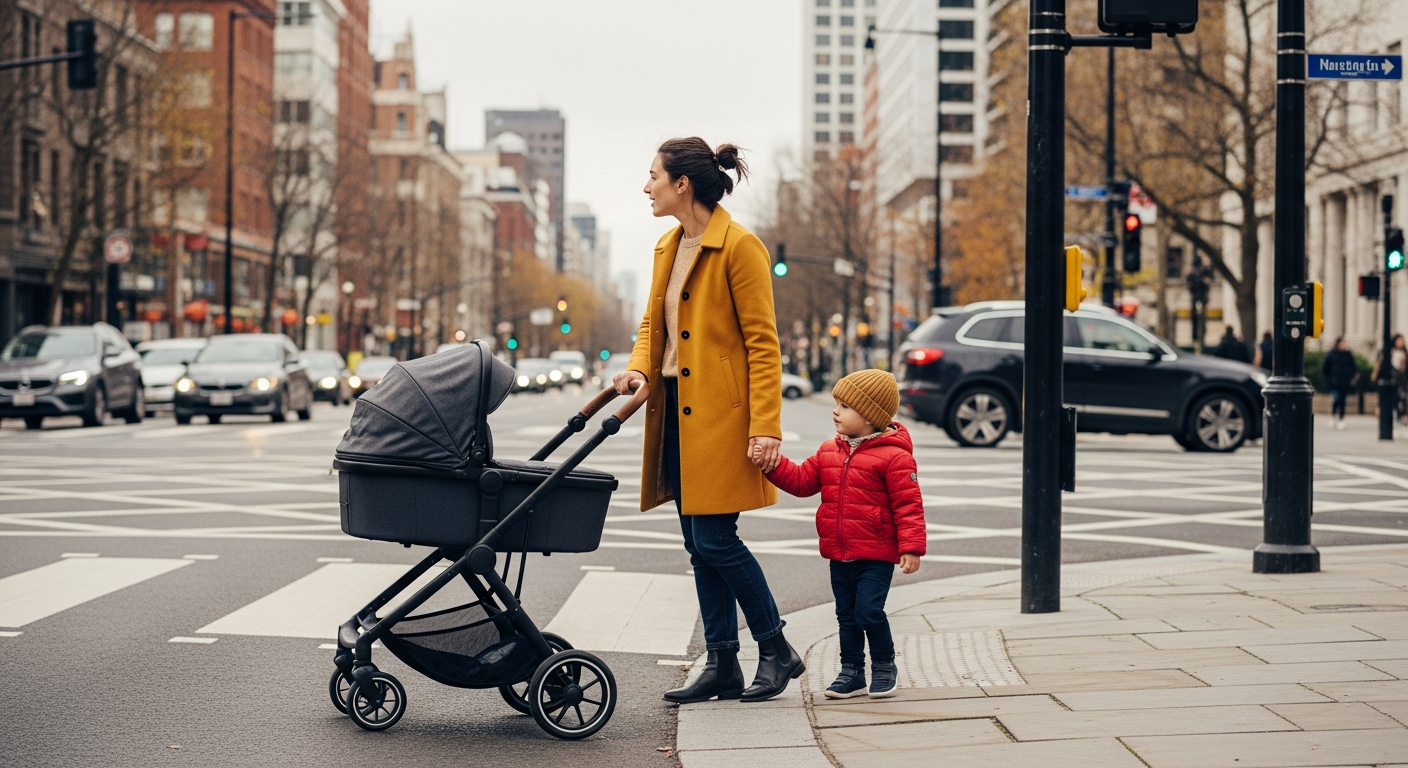
Image generated by Gemini
What Counts as a Crosswalk in New York?
Marked Crosswalks Are Easy to Spot
You know the ones: bright painted stripes or ladder-style markings spanning the street from corner to corner. These paths are typically paired with pedestrian signals and pop up near elementary schools, local parks, and busier commercial roads where foot traffic is heavy. Motorists are legally mandated to stop for pedestrians within these boundaries, giving families a designated zone to cross safely.
But here’s the thing. A pedestrian struck at a crosswalk on a well-marked road shows that paint alone can’t force a distracted driver to hit the brakes. You still need to stay alert, even when the infrastructure clearly indicates that cars should yield. Assuming a marked path works like an invisible shield is a mistake that can lead to dangerous encounters with fast-moving vehicles, especially during school pickup hours when everyone’s in a rush.
Unmarked Crosswalks Still Matter
At many neighborhood intersections, the law recognizes a pedestrian crossing even if there’s no paint on the asphalt. Under New York Vehicle and Traffic Law, a pedestrian has legal protection in both marked and unmarked crosswalks where two streets meet. Parents often assume that no paint means no right-of-way protections, but a legal crosswalk typically exists at any intersection where the curbs on opposite sides of the road meet.
This distinction matters most in residential neighborhoods where painted lines have faded over time or were simply never drawn in the first place. Sound familiar? Motorists are still expected to yield the right-of-way to families crossing at these unmarked junctions. Knowing this rule helps you cross residential streets more confidently without feeling like you have to hike several blocks just to find a painted line.
| Feature | Marked Crosswalk | Unmarked Crosswalk |
| Visible painted lines | Yes | No |
| Usually found at intersections | Yes | Yes |
| Can carry legal pedestrian protections | Yes | Yes |
| Easier for drivers to notice | Usually | Often less so |
| Requires extra caution from parents | Yes | Yes, especially since drivers may not expect pedestrians |
Who Has the Right of Way at an Intersection?
A Green Light Doesn’t Give Drivers a Free Pass
Motorists turning on a solid green light must still yield to pedestrians who are lawfully using the crosswalk in front of them. According to New York VTL §1111, a green signal permits a car to proceed, but it doesn’t cancel the driver’s legal duty to wait for people crossing the street. Plenty of motorists mistakenly believe a green light gives them absolute priority over everyone else in the intersection, and they’ll accelerate through a turn without even glancing at the crosswalk for people who also have a walk signal.
As a parent, recognizing that green lights can create a false sense of security helps you anticipate risky driver behavior. One practical trick: watch the front tires of waiting cars to see if a driver is attempting to jump the light before your family finishes crossing. Spinning tires tell you more than a driver’s face ever will.
Why Left-Turning Drivers Are a Bigger Threat
Vehicles turning left pose an outsized risk to families on foot because motorists often fixate on oncoming traffic and completely fail to scan the crosswalk. Data from the NHTSA shows that 53.1% of cross-traffic accidents happened during or immediately after a left turn. Picture yourself pushing a stroller through a wide crosswalk; stroller pushes are naturally slower, and toddlers can stop suddenly, placing them directly in the path of a driver who’s rushing to beat a yellow light.
Municipal data also shows that left turns are three times as likely to result in a fatal pedestrian accident as right turns, underscoring the danger at intersections. Police have likewise noted that many serious pedestrian crashes involve drivers turning left. A driver intensely scanning for a gap in oncoming cars may not notice a shorter toddler in the crosswalk until it’s too late, which is exactly why intersections with dedicated left-turn arrows tend to be safer for families on foot.
Why Drivers Miss People Even When They Look
You might assume a motorist looking in your direction actually registers your presence, but human perception is surprisingly flawed during complex driving maneuvers. A traffic safety analysis found that in left-turn crashes, 49% involved drivers unaware of the oncoming road user, and 30% involved drivers who misjudged the oncoming road user’s speed or gap. That’s a staggering number of collisions caused by drivers who technically “looked” but didn’t actually see anyone.
This inattentional blindness is why you should never rely purely on eye contact to confirm your family is safe to step off the curb. Drivers can look right through pedestrians because their brains are actively searching for other cars, not people or strollers. For parents who want a clearer explanation of New York rules around a driver’s duty to yield and what happens when a left turning driver hits you, local legal resources break down how liability typically works at crosswalks. Knowing the basics of how fault gets assigned can give you genuine peace of mind when navigating busy city streets with kids in tow.
How Parents Can Spot a Dangerous Intersection Before Crossing
Red Flags Families Should Notice
Predicting motorist behavior requires you to read the street environment for potential hazards before taking a single step off the curb. Failure to yield the right-of-way is consistently cited by the NYPD as the primary contributing factor in thousands of pedestrian injuries every year, which tells you everything about why environmental awareness matters. Heavy pickup and drop-off traffic near schools creates a chaotic scene in which drivers frequently rush and make careless mistakes. Think about your own school drop-off routine; you’ve probably watched at least one parent blow through a crosswalk without a second glance.
Assessing the physical layout of an intersection gives you a real advantage in keeping your children out of harm’s way. When walking with kids, watch for these warning signs before stepping into the street:
- Cars turning quickly through the light rather than yielding to foot traffic (this one’s especially common at intersections near highway on-ramps).
- Poor visibility caused by illegally parked cars or large delivery vans blocking your sightline.
- Faded road paint or missing pedestrian signal boxes.
- Drivers creeping aggressively into the crosswalk before making a complete stop.
- Wide intersections that take longer for little legs to cross, especially if you’re also managing a stroller.
- Multiple turning lanes that increase the chances of a blind spot.
- Short walk-signal timing that forces families to rush across the pavement.
Street Design Can Help, but It Isn’t a Guarantee
Urban planners are working to improve physical infrastructure by installing better lighting, raised crosswalks, and traffic-calming measures following fatal crashes in several cities. While New York City has made statistical progress in reducing traffic deaths, officials have also stated that street safety remains unfinished. Structural upgrades like curb extensions or pedestrian refuge islands certainly give walkers a safer place to stand while traffic passes.
And yes, there’s a catch. Newly painted lines and brighter lights don’t eliminate reckless or distracted drivers. Physical road improvements matter, but you still need to assess real-time motorist behavior rather than trusting traffic engineering alone to keep your kids safe. Always verify that oncoming vehicles are actually slowing down before you commit your family to the crossing; a two-second pause at the curb can make all the difference.
The Extra Challenge of Crossing With a Stroller or Toddler
Managing a neighborhood walk changes the moment you add a bulky stroller or an unpredictable toddler to the crossing equation. A recent incident where a woman and child were injured in a crosswalk collision highlights just how physically vulnerable families are in these public spaces. Strollers have wider turning radii, toddlers frequently drop hands without warning, and caregivers are often distracted by diaper bags or managing multiple siblings at once.
Here’s something a lot of parents don’t think about: pushing a stroller means the front of the carriage enters the street several feet before you actually do. All of these combined factors mean you should wait for traffic to fully stop rather than moving the instant the signal changes to white. Giving yourself that extra buffer helps make sure you aren’t caught rushing through an intersection while pulling a reluctant two-year-old behind you.
Smart Family Habits That Make Crosswalks Safer
Teach Kids the “Stop, Look, Listen, Wait” Routine
Safety officials continue to urge pedestrians to follow crosswalk rules ahead of busy family walking seasons, and building consistent routines at a young age really does work. Toddlers need direct physical control (holding hands or gripping the stroller frame) rather than relying on verbal reminders alone. Preschoolers can practice stopping right at the curb and pointing out the cars they see before moving forward. School-aged children can learn to actively scan for turning cars over their shoulders before stepping down.
Repeating these simple habits on every single walk builds muscle memory that children carry into their teenage years and beyond. Ask any parent who’s been doing this consistently, and they’ll tell you the same thing: kids start doing it on their own faster than you’d expect. Consistent modeling shows your children that safety is a non-negotiable part of leaving the house, not something you only do “sometimes.”
Make Eye Contact, Then Verify the Car Has Actually Stopped
While making eye contact with a motorist is a good starting point, vehicle movement determines the actual level of danger your family faces. Eye contact from a turning driver isn’t enough. So what does that tell you? That a motorist looking directly at you might actually be looking through you while they focus on an oncoming delivery truck or an Uber trying to merge.
If the vehicle’s wheels are still rolling forward, it isn’t safe to enter the crossing path with your children. Teach your kids to watch the car’s tires rather than the driver’s face, since moving wheels reveal a vehicle’s true intent. Waiting for a complete stop removes much of the guesswork from your daily walking routine, and honestly, those extra few seconds are never wasted.
Model Safe Walking When Pets or Multiple Kids Are Involved
Walking a family dog alongside small children requires intense focus, because managing a leash and a stroller near moving traffic can quickly divide your attention. Not where you expected this guide to go, right? But if your walks regularly include both kids and pets, choosing gear that gives you better physical control can help reduce dangerous distractions near busy streets. A guide to getting the right dog harness may help make family walks feel more manageable and a lot less chaotic.
Every driver has a statutory duty to exercise due care around pedestrians, but maintaining physical control over your pets and children also helps prevent unpredictable street entries. Keep dogs on a short leash and require kids to stay behind the dog rather than run ahead toward the curb. Preparing your walking arrangement before leaving the driveway helps make sure your hands and eyes are ready for the intersection ahead.
What Parents Should Know If a Driver Hits a Pedestrian
Safety and Medical Care Come First
If the unthinkable happens, getting immediate safety and professional medical attention is the top priority. Move your family to a safe location off the roadway if possible, and call 911 immediately so emergency responders can document the scene. Get checked medically even if the injuries seem minor or if you only felt a slight bump from the vehicle; adrenaline masks pain more than most people realize.
Young children, especially, may not express physical pain clearly after such a frightening event, which can hide symptoms of a real problem. Responders note that serious but non-life-threatening injuries still require immediate professional assessment to rule out hidden internal damage. Prioritizing your family’s health over arguing with the driver at the scene helps make sure everyone gets the care they need.
What Information Helps Later
Collecting accurate details at the scene protects your family’s rights and helps clarify the sequence of events for local authorities. Take clear photos of the intersection, the vehicle’s final resting position, and any visible traffic signals that dictate the right of way. Gather names and phone numbers from witnesses who stopped, and note the exact location of nearby security cameras on local storefronts (coffee shops and banks almost always have them).
Always request the official police report number, as police will close an intersection to investigate a collision and record important statements from drivers. Keeping a careful track of medical records, hospital bills, and insurance communications gives you a clear paper trail moving forward. This documentation can also prevent at-fault motorists from changing their story weeks later when the details start to blur.
Why Crosswalk Details Matter
The specific layout of the street heavily influences liability and legal protections after a crash between a vehicle and a pedestrian. Noting whether the crosswalk was marked or unmarked, whether the pedestrian signal was active, and whether the motorist was executing a turn helps establish the basic facts of what happened. Documenting that a driver failed to exercise due care around pedestrians helps make sure the official record accurately reflects the driver’s breach of duty.
These intersection details form the foundation of your legal position if you need to pursue compensation for medical bills. Insurance adjusters will scrutinize your location on the road, so clearly explaining your lawful presence in the crosswalk can help protect your claim. Providing this information promptly to your legal counsel also helps streamline the recovery process, and the sooner you get organized, the less stressful the whole experience tends to be.
Confidence Matters More Than Hurry
You don’t need to memorize every traffic statute, but understanding a few basic rules helps your family make safer choices at street level. Recognizing that both marked and unmarked crosswalks carry legal weight, and knowing that turning drivers demand extra scrutiny, empowers you to cross with more confidence. Left-turning vehicles are responsible for most pedestrian deaths that occur during a turn in New York City, which tells you that caution is justified regardless of what the signal says.
The safest crossing choice is usually the one that gives you more time, better visibility, and fewer surprise vehicle movements. Trusting your instincts, choosing a slightly longer but safer route, and modeling calm habits will help you raise genuinely street-smart kids.

Leave A Comment